

In a race with 10 participants, in how many ways can the podium (1st, 2nd, 3rd place) be filled? Here we use only 3 of the 10 athletes, and order matters (1st ≠ 2nd). This is an arrangement (also called an r-permutation).
Why arrangements? #
Selecting and ordering a subset of elements, without necessarily using all of them, is a core operation in computing and mathematics:
- Security: passwords of length \(r\) with no repetition, drawn from an alphabet of \(n\) symbols, add up to \(A(n, r)\) possibilities, and the arrangement sizes the space a brute-force attacker has to search.
- License plates and unique identifiers: alphanumeric systems with no repeated characters use the arrangement to compute how many distinct identifiers can be issued, exactly the example solved below.
- Scheduling: ordering \(r\) processes out of \(n\) available in a priority queue corresponds to \(A(n, r)\) possible sequences.
- Routes and graphs: the number of simple paths that go through \(r\) distinct vertices, in order, in a complete graph with \(n\) vertices is \(A(n, r)\), the basis of state-space search algorithms.
- Rankings: podiums, ordered recommendation lists, and tournament results are arrangements, because it matters who was chosen and in which position.
From permutation to arrangement #
The permutation, covered in the previous article, orders all \(n\) elements. The arrangement relaxes that requirement: we order only \(r < n\) of them. The diagram below places the arrangement in the family of groupings:
flowchart TD
    A["n distinct elements"] --> B{"Use all of them?"}
    B -->|"Yes"| C["Permutation
P_n = n!"]
    B -->|"No: choose r < n"| D{"Does order matter?"}
    D -->|"Yes"| E["Arrangement
A(n,r) = n!/(n-r)!"]
    D -->|"No"| F["Combination
(next article)"]
Arrangement #
An arrangement of \(n\) distinct elements taken \(r\) at a time (an r-permutation) is an ordered selection of \(r\) distinct elements chosen from \(n\) (\(r \leq n\)):
$$A(n, r) = \frac{n!}{(n-r)!} = n \cdot (n-1) \cdots (n-r+1)$$In the international literature, the same number usually appears as
\(P(n, r)\) or \({}_{n}P_{r}\), from permutation, and it is the nPr
key on scientific calculators.
Notable cases:
- \(A(n, n) = n!\), the same as the permutation \(P_n\)
- \(A(n, 1) = n\)
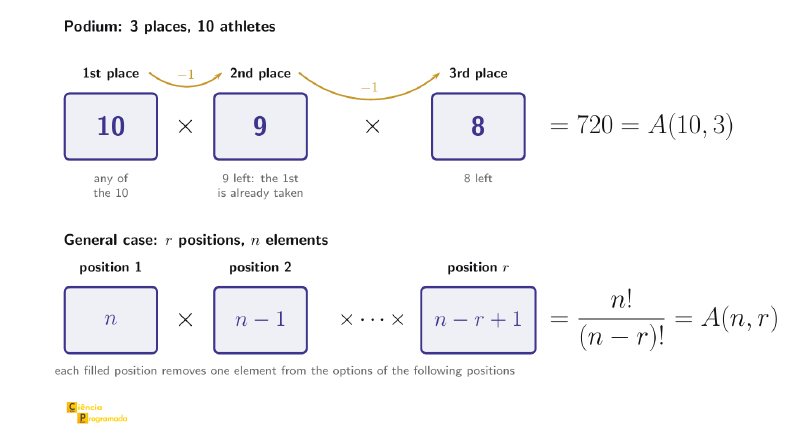
Back to the opening example: the podium of a race with 10 athletes has \(A(10, 3) = 10 \times 9 \times 8 = 720\) distinct configurations.
The figure below shows where this product comes from. Each podium place is a little box with the number of athletes still available for it, and each filled place leaves one athlete fewer for the following ones; in the general case, the \(r\) boxes carry \(n, n-1, \ldots, n-r+1\):
Worked Examples #
Building with 8 floors: distinct (entry, exit) pair #
Problem: A building has 8 floors. A person gets in the elevator on one floor and gets out on a different one. In how many distinct ways can this ordered (entry, exit) pair occur?
Solution: We want to choose 2 distinct floors out of 8, where order matters, since getting in at the 3rd and out at the 7th is different from getting in at the 7th and out at the 3rd. This is an arrangement of 8 elements taken 2 at a time.
We fill the two positions sequentially:
| Position | Available options | Justification |
|---|---|---|
| Entry floor | 8 | any of the 8 floors |
| Exit floor | 7 | any except the entry floor |
SQL: CROSS JOIN with a filter generates distinct ordered pairs
CROSS JOIN with a filter generates distinct ordered pairs
In the article on the Sum and Product Rules,
we saw that CROSS JOIN, an SQL (Structured Query Language) operation that
generates the Cartesian product of tables, produces \(n^2\) pairs. Adding WHERE a.floor <> b.floor eliminates the \(n\)
diagonal pairs where entry = exit and produces exactly the \(A(n, 2)\)
ordered pairs:
CREATE TABLE floors (floor INT);
INSERT INTO floors VALUES (1),(2),(3),(4),(5),(6),(7),(8);

SELECT a.floor AS entry, b.floor AS exit
FROM   floors a
CROSS JOIN floors b
WHERE  a.floor <> b.floor
ORDER BY entry, exit;
-- 56 rows = A(8, 2)

SELECT COUNT(*)
FROM   floors a
CROSS JOIN floors b
WHERE  a.floor <> b.floor;
-- 56
The condition WHERE a.floor <> b.floor is exactly what distinguishes the
arrangement \(A(n, 2) = n(n-1)\) from the Cartesian product \(n^2\): it
removes the \(n\) rows where the person would get in and out on the same
floor.
Schedule of 3 activities out of 4 #
Problem: A student has 4 activities available: reading (R), exercise (E), drawing (D), and cooking (C). They want to put together a daily schedule with 3 of these activities in a fixed sequence: order matters, because it determines what they will do in the morning, afternoon, and evening. In how many distinct ways can they put together this schedule?
Solution: We want to select and order 3 distinct activities out of 4. We fill the three positions sequentially, with no repetition:
| Period | Available options | Justification |
|---|---|---|
| Morning | 4 | any of the 4 activities |
| Afternoon | 3 | any except the morning one |
| Evening | 2 | any except the two already chosen |
Routes among 5 cities: ordered route of 3 cities #
Problem: A traveler needs to plan a route that goes through exactly 3 cities among São Paulo, Rio de Janeiro, Belo Horizonte, Porto Alegre, and Curitiba. The order of the cities visited determines the route: SP → RJ → BH is different from RJ → SP → BH. How many distinct routes can they plan?
Solution: We want an ordered sequence of 3 distinct cities chosen from 5. We fill the three stages of the route sequentially:
| Route stage | Available options | Justification |
|---|---|---|
| 1st city | 5 | any of the 5 cities |
| 2nd city | 4 | any except the 1st |
| 3rd city | 3 | any except the previous two |
Python: itertools.permutations and the arrangement formula
itertools.permutations and the arrangement formula
itertools.permutations(iterable, r) generates exactly the \(A(n, r)\)
arrangements of \(r\) distinct elements drawn from a sequence of \(n\) unique elements (the function distinguishes them by
position, not by value):
import itertools, math

# A(5, 3) — routes of 3 cities among 5
cities = ["SP", "RJ", "BH", "POA", "CWB"]
routes = list(itertools.permutations(cities, 3))
print(len(routes))                         # 60

# Confirm with the formula
def arrangement(n, r):
    return math.factorial(n) // math.factorial(n - r)

print(arrangement(5, 3))                   # 60
For large \(n\) and \(r\), never materialize the iterator as a list; prefer counting with the formula. \(A(26, 3) \times A(10, 4) = 78{,}624{,}000\) objects would demand prohibitive memory.
SQL: triple CROSS JOIN for routes of 3 cities
CROSS JOIN for routes of 3 cities
Extending the pattern from the article on the Sum and Product Rules: three chained CROSS JOINs with distinctness filters generate \(A(n, 3)\) ordered routes without revisiting cities.
CREATE TABLE cities (city TEXT);
INSERT INTO cities VALUES ('SP'),('RJ'),('BH'),('POA'),('CWB');

SELECT a.city AS origin,
       b.city AS stopover,
       c.city AS destination
FROM   cities a
CROSS JOIN cities b
CROSS JOIN cities c
WHERE  a.city <> b.city
  AND  b.city <> c.city
  AND  a.city <> c.city
ORDER BY origin, stopover, destination;

SELECT COUNT(*)
FROM   cities a
CROSS JOIN cities b
CROSS JOIN cities c
WHERE  a.city <> b.city
  AND  b.city <> c.city
  AND  a.city <> c.city;
-- 60 = A(5, 3)
The pattern generalizes to any \(r\): we chain \(r\) copies of the table
with CROSS JOIN and filter all pairs of aliases with <>. For large
\(r\), this approach becomes impractical in SQL, so use the formula.
License plates: 3 letters and 4 distinct digits #
Problem: A plate system uses the format AAA-NNNN, with 3 letters of the alphabet (26 letters) followed by 4 digits (from 0 to 9). No letter may repeat in the 3 letter positions, and no digit may repeat in the 4 digit positions. How many distinct plates can be issued?
Solution: Choosing the letters and choosing the digits are independent steps, so we apply the Product Rule between the two blocks.
Letter block, \(A(26, 3)\): we select and order 3 distinct letters out of 26.
| Position | Available options | Justification |
|---|---|---|
| 1st letter | 26 | any of the 26 letters |
| 2nd letter | 25 | any except the 1st |
| 3rd letter | 24 | any except the previous two |
Digit block, \(A(10, 4)\): we select and order 4 distinct digits out of 10.
| Position | Available options | Justification |
|---|---|---|
| 1st digit | 10 | any of the digits from 0 to 9 |
| 2nd digit | 9 | any except the 1st |
| 3rd digit | 8 | any except the previous two |
| 4th digit | 7 | any except the previous three |
Total, by the Product Rule between the two blocks:
$$A(26, 3) \times A(10, 4) = 15{,}600 \times 5{,}040 = \mathbf{78{,}624{,}000}$$3-digit numbers with distinct digits from \(\{0, 1, \ldots, 9\}\) #
Problem: How many 3-digit numbers (between 100 and 999), with all digits distinct, can be formed with the digits \(\{0, 1, \ldots, 9\}\)?
Solution: The difficulty is the restriction: the 1st digit cannot be 0, otherwise the number would effectively have only 2 digits (e.g., 053 = 53). We present two approaches.
Direct approach (fill the restricted position first):
The strategy is always to start with the position that has a restriction, then fill the others.
| Position | Available options | Justification |
|---|---|---|
| Hundreds (1st) | 9 | digits from 1 to 9 (0 excluded) |
| Tens (2nd) | 9 | digits from 0 to 9 except the hundreds digit (0 is an option again) |
| Units (3rd) | 8 | digits from 0 to 9 except the two already used |
Check by complement:
We count all arrangements of 3 distinct digits (including those that start with 0) and subtract the invalid ones:
- Total without restriction: \(A(10, 3) = 10 \times 9 \times 8 = 720\)
- Start with 0: 0 fixed in the 1st position, 2 digits chosen from the remaining 9 → \(A(9, 2) = 9 \times 8 = 72\)
Python: generating and checking PINs with no repeated digits
This example is the classic problem of sizing the space of PINs (Personal Identification Numbers) with no repetition, a context introduced in the section Why arrangements?. The code below enumerates the PINs, applies the validity filter, and confirms the complement method:
from itertools import permutations

digits = range(10)  # {0, 1, ..., 9}

# All arrangements of 3 distinct digits (including those starting with 0)
all_pins = list(permutations(digits, 3))
print(len(all_pins))  # 720 = A(10, 3)

# Only those valid as a 3-digit number (no 0 in the 1st position)
valid = [p for p in all_pins if p[0] != 0]
print(len(valid))     # 648

# Invalid cases: start with 0 → A(9, 2) arrangements of the 9 remaining digits
invalid = [p for p in all_pins if p[0] == 0]
print(len(invalid))   # 72 = A(9, 2)

# Confirm the complement
assert len(valid) + len(invalid) == len(all_pins)  # 648 + 72 = 720 ✓
The last line confirms in code what we did on paper: \(A(10, 3) - A(9, 2) = 720 - 72 = 648\).
Even 4-digit numbers with distinct digits from \(\{0,1,\ldots,9\}\) #
Problem: How many 4-digit numbers (between 1000 and 9999), with all digits distinct, are even, using the digits \(\{0, 1, \ldots, 9\}\)?
Solution: A number is even when its last digit (units) belongs to \(\{0, 2, 4, 6, 8\}\). We split into two cases according to the final digit, because the restriction on the 1st digit (≠ 0) changes depending on which even digit occupies the last position.
Case I (last digit = 0):
With 0 fixed in the last position, it cannot appear in the 1st, so the restriction on the 1st digit is already satisfied.
| Position | Available options | Justification |
|---|---|---|
| Units (4th) | 1 | fixed at 0 |
| Thousands (1st) | 9 | digits from 1 to 9 (0 already used) |
| Hundreds (2nd) | 8 | remaining digits except the two already used |
| Tens (3rd) | 7 | remaining digits |
Case II (last digit \(\in \{2, 4, 6, 8\}\)):
Now 0 was not used in the last position, so it remains forbidden in the 1st position.
| Position | Available options | Justification |
|---|---|---|
| Units (4th) | 4 | choice from \(\{2, 4, 6, 8\}\) |
| Thousands (1st) | 8 | digits from 1 to 9 except the one already used in the units |
| Hundreds (2nd) | 8 | digits from 0 to 9 except the two already used (0 is an option again) |
| Tens (3rd) | 7 | remaining digits |
Total, by the Sum Rule between the two cases:
$$M_1 + M_2 = 504 + 1{,}792 = \mathbf{2{,}296}$$Summary Table: Permutation vs. Arrangement #
| Concept | Uses all? | Order matters? | Formula |
|---|---|---|---|
| Permutation | Yes | Yes | \(n!\) |
| Arrangement | No (\(r < n\)) | Yes | \(\dfrac{n!}{(n-r)!}\) |
In general, it is convenient to start the analysis with the positions that have special restrictions (e.g., it cannot be 0 in the first position).
Exercises #
Exercise 1: Coordinator and deputy coordinator
In a committee of 10 professors, in how many ways can a coordinator and a deputy coordinator be chosen?
Answer
Order matters (coordinator ≠ deputy coordinator):
$$A(10,2) = 10 \times 9 = \mathbf{90}$$
Exercise 2: Finding \(n\)
(a) If \(A(n,2) = 72\), find \(n\). (b) If \(4A(n,2) = A(2n,3)\), is there a solution?
Solution
(a) \(n(n-1) = 72 \Rightarrow n^2 - n - 72 = 0 \Rightarrow \mathbf{n = 9}\)
(b) \(4n(n-1) = 2n(2n-1)(2n-2) = 4n(n-1)(2n-1)\). Dividing both sides by \(4n(n-1)\) (valid for \(n \geq 2\)): \(1 = 2n-1 \Rightarrow n = 1\). But this contradicts \(n \geq 2\). There is no solution.
Exercise 3: Photo of 4 friends out of 10
In how many ways can 4 friends out of 10 line up for a photo?
Answer
Order (position in the photo) matters:
$$A(10,4) = 10 \times 9 \times 8 \times 7 = \mathbf{5{,}040}$$
Exercise 4: Airline tickets
An airline connects 7 cities. How many types of tickets (origin → destination) exist?
Answer
\(A(7,2) = 7 \times 6 = \mathbf{42}\)
Exercise 5: 3-digit numbers from \(\{2,3,5,8,9\}\)
With the digits \(\{2,3,5,8,9\}\), count the 3-digit numbers with distinct digits that are: (a) multiples of 5 (b) even (c) odd (d) less than 800
Solution
(a) Units = 5: \(A(4,2) = \mathbf{12}\)
(b) Units \(\in \{2,8\}\): \(2 \times A(4,2) = \mathbf{24}\)
(c) Units \(\in \{3,5,9\}\): \(3 \times A(4,2) = \mathbf{36}\)
(d) Hundreds \(\in \{2,3,5\}\): \(3 \times A(4,2) = \mathbf{36}\)
Next steps #
The arrangement solves the case where order matters and we use only \(r < n\) elements. Its limitation is exactly that requirement of order: in many practical situations (forming a committee, choosing the ingredients of a recipe, selecting movies to watch) all that matters is which elements were chosen, not in what sequence.
When order does not matter, we arrive at combinations, the next topic in the series. With permutations, arrangements, and combinations we will have the fundamental triad of combinatorics, enough to solve the vast majority of counting problems.


