

How can a plane run out of fuel at 12 km of altitude? Today’s article is about a Boeing that became a 100-ton-plus “glider” and how it all happened because of a simple unit conversion error.
If you prefer to watch a video (in Portuguese), click the player below. The full article follows the video.
About the plane #
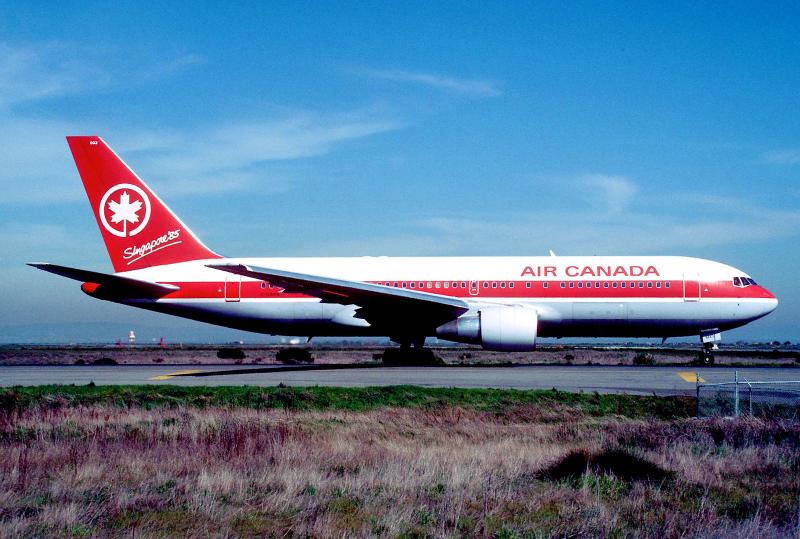
In 1978 Boeing began developing the 767 line, its first twin-engine widebody (twin-aisle) aircraft, which came with several technological novelties, especially electronic displays. In the money of the time, the aircraft cost 40 million dollars. The plane in our story is the Boeing 767-200 that operated Air Canada flight 143 between Montreal and Edmonton, with a stop in Ottawa, on July 23, 1983. The flight crew was very experienced, with Captain Robert Pearson having more than 15,000 flight hours and First Officer Maurice Quintal more than 7,000 flight hours.
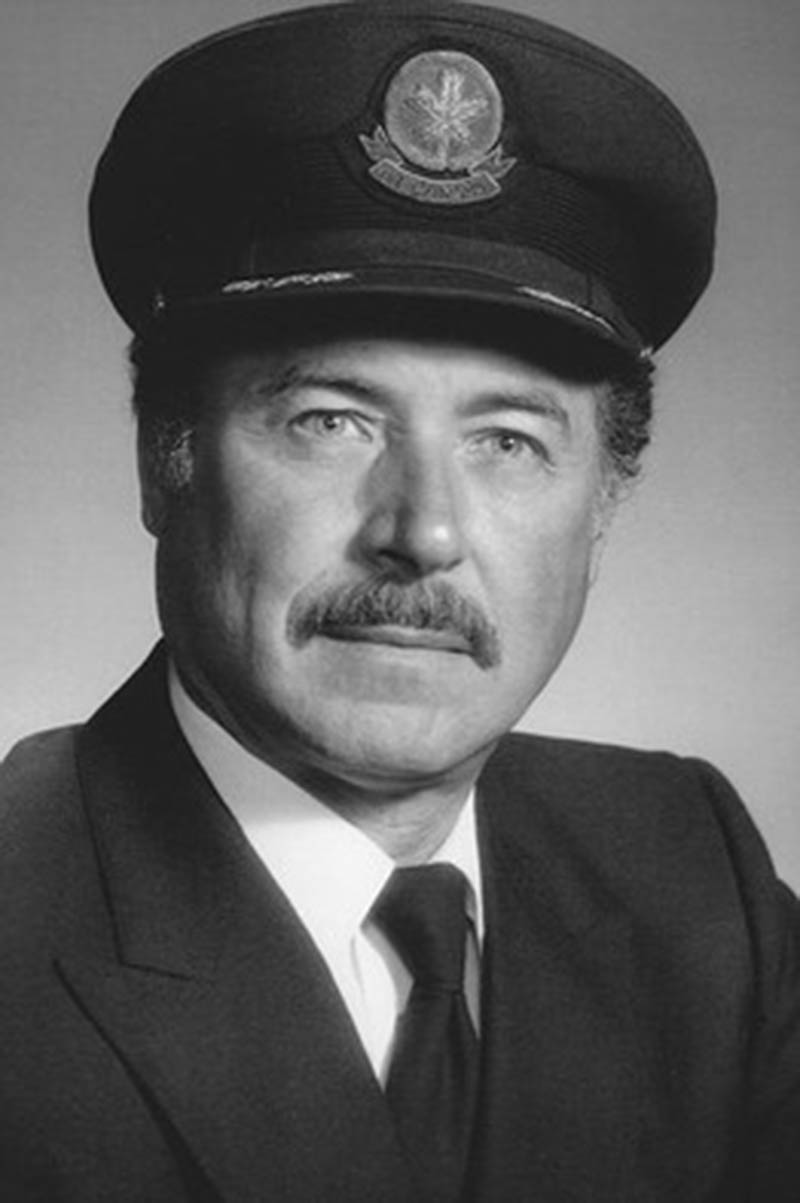
In the photo, Captain Pearson:
The incident #
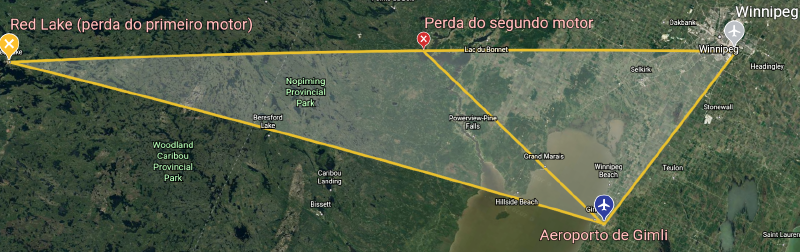
While the plane was flying over Red Lake, Ontario, at an altitude of 41,000 feet (12.5 km), the cockpit warning system alarm went off, indicating a fuel pressure problem. The pilots assumed it was a fuel pump problem and turned the pump off, since gravity would still deliver fuel to the engines. The onboard computer indicated (wrongly, as we will see later) that there was enough fuel to fly. A short time later the left engine flamed out and the pilots, in contact with air traffic control, diverted the flight to Winnipeg. Air traffic control said they were 120 nautical miles (222 km) from Winnipeg airport.
While they were changing course and talking to air traffic control, a new alert came: this time indicating that all the engines had failed and, shortly after, the right engine stopped working. The 767 was one of the first planes to have an Electronic Flight Instrument System, which ran on electricity generated by the engines. With no engines, the system became inoperative, leaving only a few instruments powered by the emergency battery. The remaining instruments gave enough information to land the plane. However, there was no information about the aircraft’s vertical speed, which would indicate its rate of descent, a piece of information needed to calculate how long the aircraft could keep gliding. At that moment, the Winnipeg control tower said they were about 65 nautical miles from Winnipeg.
The engines also powered the plane’s hydraulic systems. With their loss, a backup system is activated, which consists of turbines that generate power from the movement of the air. So, as the speed decreased, less power was available to the hydraulic systems, which are essential for good control at landing.
The glider Boeing #
Situations like this were not part of the pilots’ training, nor did the aircraft’s emergency instructions describe the procedures to follow in a no-engine situation. Luckily, Captain Pearson had a lot of experience with gliders and used all that knowledge to avoid a disaster.
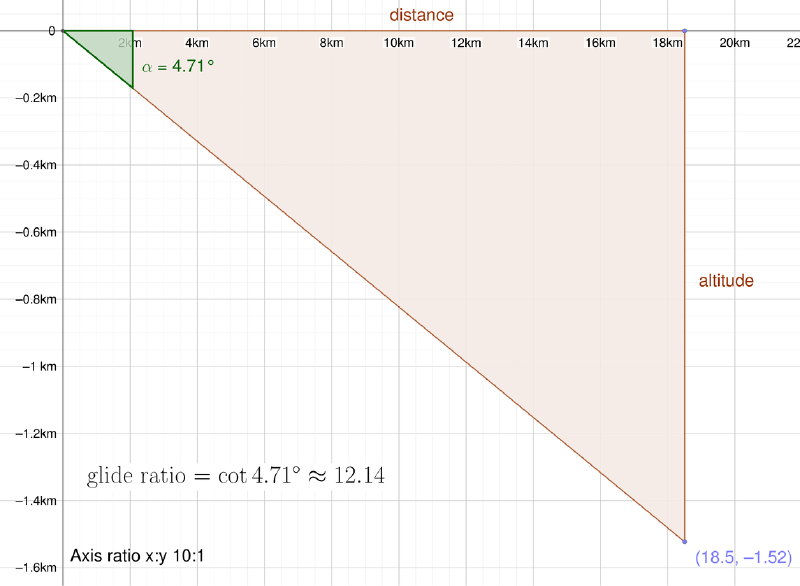
The first piece of information Pearson needed was the speed he had to maintain to glide. From practical knowledge, he estimated it would be 220 knots (407 km/h). As written earlier, the plane did not display the rate of descent. So he and Quintal stayed in constant contact with air traffic control, since control could report the altitude from the information collected by radar. They then estimated that for every 10 nautical miles the plane lost 5,000 feet of altitude. With that he could calculate the glide ratio, that is, the ratio between the horizontal distance traveled and the height lost. Let’s do this calculation, taking the opportunity to convert the data to the International System of Units:
$$10\ \text{M} \approx 18.52\ \text{km}$$$$5{,}000\ \text{ft} \approx 1.524\ \text{km}$$$$\begin{aligned} \text{glide ratio} &= \frac{18.52\ \text{km}}{1.524\ \text{km}} \\ &= 12.15 \approx 12:1 \end{aligned}$$Here, M is the symbol for nautical mile and ft is the symbol for feet.
That is, for every 12 km they advanced horizontally, they lost 1 km of height. Just for comparison, gliders usually have glide ratios above 30:1. Notice, in the following figure, that the glide ratio is nothing more than the cotangent of the descent angle:
At the moment they were making these calculations, they were at 35,000 feet of altitude, so the maximum they could advance is:
$$\begin{aligned} &12 \times 35{,}000\ \text{ft} \\ &\quad \times 3.048 \times 10^{-4}\ \text{km}\ \text{ft}^{-1} \\ &\approx 128\ \text{km} \end{aligned}$$As written earlier, at the moment they were making these calculations they were about 65 nautical miles from Winnipeg, which is equivalent to 120 km. Mathematically, then, it seems they could reach Winnipeg. But, since the plane’s speed would have to decrease on the approach for descent, it would not be possible to go to Winnipeg. In addition, since the plane’s main system was disabled, the position given by radar was not very accurate because the plane’s transponder was not working, so they needed a margin of error in these values.
Quintal then proposed landing at an airfield in Gimli, where he had served as a pilot in the Canadian Air Force. The distance to Gimli was 45 nautical miles (83 km), which would be safer. Let’s see on the map roughly what the situation was in terms of distances.
Without power, the landing gear had to be lowered by gravity. However, the nose landing gear did not lock in the correct position. To reduce altitude and speed for landing, Pearson banked the aircraft to expose more area, increasing drag and decreasing the flight height. And as they approached the runway it also became evident that there was some activity going on. And there really was. Part of the runway was being used for a go-kart race and there were family campsites around the track! And, since the plane had no engines, it made no noise, so the public only realized what was happening when the plane was almost touching the runway.
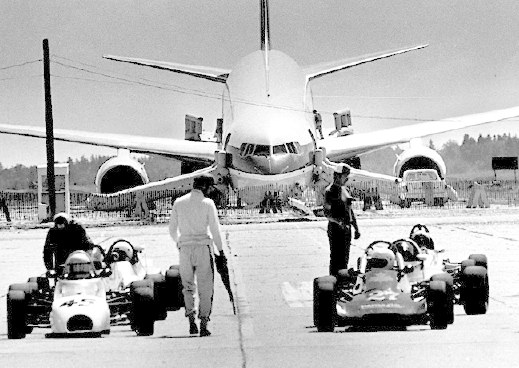
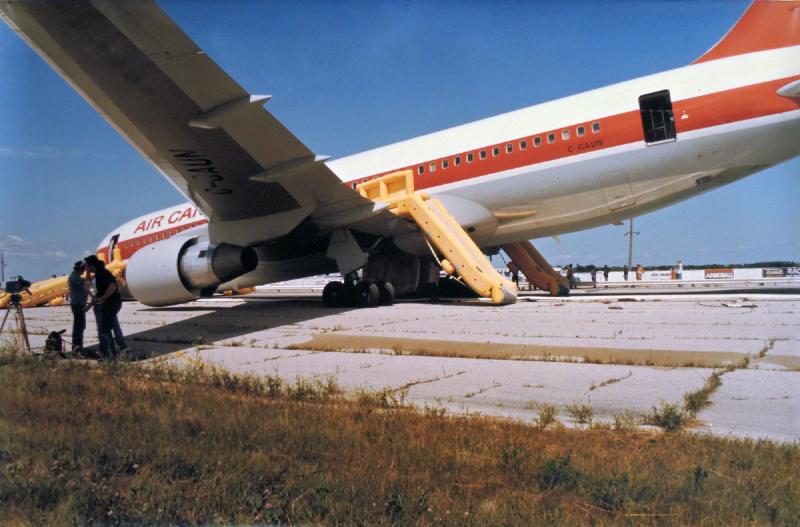
When the main landing gear touched the runway, Pearson braked with all his strength, blowing out two tires. Since the aircraft’s nose landing gear had not locked, the nose started to drag on the ground. Fortunately this helped reduce the speed and the plane did not leave the runway, nor did it hit any of the people or campsites. None of the 61 passengers were seriously injured; some had minor injuries during the evacuation because the rear of the plane was very high and the slides were not tall enough.
The photo shows the position where the plane stopped:
But after all, why did all this happen?
The unit mix-up #
The accident report shows, as always in the case of large-scale accidents, that there was a series of factors that culminated in the forced landing at Gimli. Several internal communication problems were pointed out, in addition to failures to follow standard procedures. But one aspect is of interest to us here: a unit conversion failure.
At the time of the incident, the Canadian aviation sector was in the process of migrating to the metric system (the International System of Units). The Boeing 767 was the first plane acquired by Air Canada whose instruments were already in the metric system (liters and kilograms), instead of imperial units (gallons and pounds). All the company’s other aircraft used imperial units.
For the trip to Edmonton, the pilot calculated that 22,300 kg (49,163 lb) of fuel would be needed. The company’s maintenance technicians checked that there were already 7,682 liters in the tank. To calculate how much fuel should be added, the crew had to convert the volume to mass, subtract it from the total mass required, and convert back to volume.
The density to be used was 0.803 kg/l. So, the correct calculations would be:
- Fuel mass already present: \(7{,}682 \text{ L} \times 0.803 \text{ kg L}^{-1} = 6{,}169 \text{ kg}\)
- Fuel mass to add: \(22{,}300 \text{ kg} - 6{,}169 \text{ kg} = 16{,}131 \text{ kg}\)
- Conversion to volume: \(\dfrac{16{,}131 \text{ kg}}{0.803 \text{ kg L}^{-1}} = 20{,}088 \text{ L}\)
However, since the custom was to use the imperial system of units, the staff understood that 22,300 pounds of fuel were needed and used a density value of 1.77 lb/l. The volume of fuel, like that of any liquid, varies with temperature. So, it is normal for the maintenance crew to consult density versus temperature tables to know which value to use. In this case, the fuel supplier’s instructions indicated that this was indeed the density for that day’s conditions. Since the custom was to work in pounds and use values close to this one, no one noticed the error. So, for them the calculations were:
- Fuel mass already present: \(7{,}682 \text{ L} \times 1.77 \text{ lb L}^{-1} = 13{,}597 \text{ lb}\)
- Fuel mass to add: \(22{,}300 \text{ lb} - 13{,}597 \text{ lb} = 8{,}703 \text{ lb}\)
- Conversion to volume: \(\dfrac{8{,}703 \text{ lb}}{1.77 \text{ lb L}^{-1}} = 4{,}917 \text{ L}\)
Thus, instead of fueling with 20,088 liters, the plane was fueled with only 4,917 liters (in fact, 5,000 liters, by rounding according to the report).
Far beyond a simple unit error… #
The accident report shows that it was a collective error. Neither the maintenance crew nor the pilots, after the causes of the accident were investigated, could answer exactly what the conversion procedure was. The calculations, however simple, were done by many hands and no one noticed that the density was in the wrong unit. All the checks that were made were purely numerical, since no one suspected the units.
The report also points out that, had those involved consulted the flight operations manual, the conversion procedure would have been described correctly. However, those involved were not in the habit of following this procedure because, on other company flights with older planes, the crew included a flight engineer, who was responsible for these calculations. On this modern plane, the company considered a flight engineer unnecessary but did not reassign this checking duty to anyone else.
Another link in this incident is the fact that the fuel indication system was inoperative. On this plane, it was a dual system, each processor channel calculating the amount of fuel independently. So, even if one failed, there was still the other. And, in this kind of situation, the procedure is to check the amount of fuel manually at each stop, with the aid of rulers, by maintenance technicians. The check was done both in Montreal and in Ottawa, but on this flight both channels were faulty. Thus, the aircraft should not have been cleared to fly according to the procedures described in the flight manuals.
However, due to several misunderstandings, Pearson understood that he could fly if the amount of fuel had been checked by the maintenance technicians. What contributed to this understanding was that the procedures in this aircraft’s manuals, more specifically in the Minimum Equipment List (MEL), changed often, because the plane was still new and adjustments were being made, so it was common for flights to be cleared by maintenance technicians even when contradicting the manual’s guidelines.
With the indication system inoperative, the pilots had to manually enter the amount in the fuel tanks into the onboard computer so that it could calculate fuel consumption. So, the value entered was wrong.
Conclusion #
Although it seems that the unit conversion was the main cause of this accident, we see that, if all the procedures had been followed correctly, there would have been several chances for the error to be noticed. Several layers of safety were broken, by several characters in the story.
Moreover, although the pilots’ skill was essential to save the lives of everyone on board, their errors, uncovered by the investigation, of not following procedures led to their being removed from the company’s activities for a while. Air Canada was also penalized for having operations that allowed this whole chain of poor communication and that allow activities to be carried out without being provided for.
How can you avoid making this kind of mistake in your professional life? First, follow formally established procedures. After all, that is what they are for. And, if you are going to do calculations, write the values with their respective units. By the way, I have already written here about a calculator that makes calculations with units easier, so be sure to check it out. Dimensional analysis is simple and would easily reveal conflicting units.
See you in the next article!


